
Returning After 54 Years: What Artemis II Set in Motion, Part 1
The return to crewed lunar flight: Artemis II’s people, spacecraft, flight plan, and the political stakes behind the mission.
Who this is for
For readers getting to know Artemis II’s background, crew, and flight sequence for the first time.

At 7:35 a.m. Korean time on April 2, 2026, a column of fire rose from Launch Pad 39B at Kennedy Space Center in Florida. The rocket produced 8.8 million pounds of thrust, roughly 4,000 metric tons-force. It took little more than eight minutes for that force to carry a capsule with four people toward its initial Earth orbit. The last time humans had set out in this direction was 1972. Fifty-four years had passed.
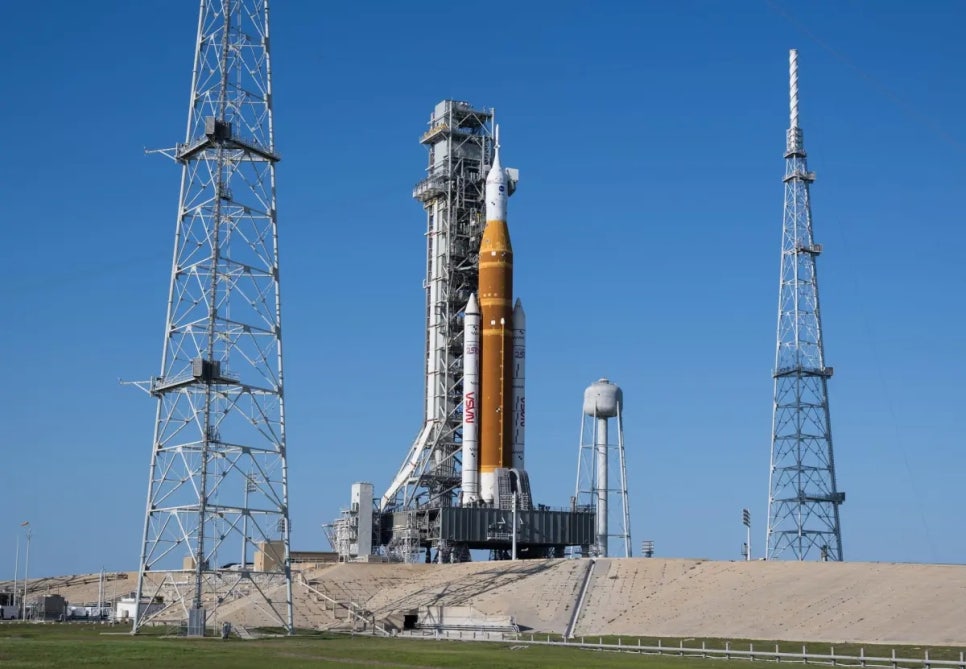
SLS (Space Launch System)
The end of Apollo and the beginning of Artemis
On December 14, 1972, Apollo 17 astronaut Eugene Cernan climbed the ladder after leaving the last human footprints on the Moon. His farewell expressed a belief that humanity would return, God willing. For more than half a century, that promise remained unfulfilled.
As the excitement of the lunar race faded and American policy priorities shifted, Apollo’s budget declined. The program quietly ended under the weight of its enormous cost, and the Moon receded from humanity’s immediate attention. Meanwhile, the world changed. The Soviet Union collapsed, China entered the space race, and private companies began building rockets.
In Greek mythology, Artemis is Apollo’s twin sister and a goddess associated with the Moon. The name deliberately invokes that history. Artemis begins where Apollo ended.
Flight overview
The first crewed lunar flyby since 1972. Total flight time: approximately 9 days, 1 hour, and 32 minutes.
Maximum distance from Earth: approximately 406,771 km. Launch thrust: 8.8 million pounds, or roughly 4,000 metric tons-force.
Who is going this time?
The Artemis II Orion spacecraft is named Integrity. Four crew members travel toward the Moon under that name. Their milestones are more than statistics. They also reveal how narrowly access to space exploration has been distributed for the past half-century.
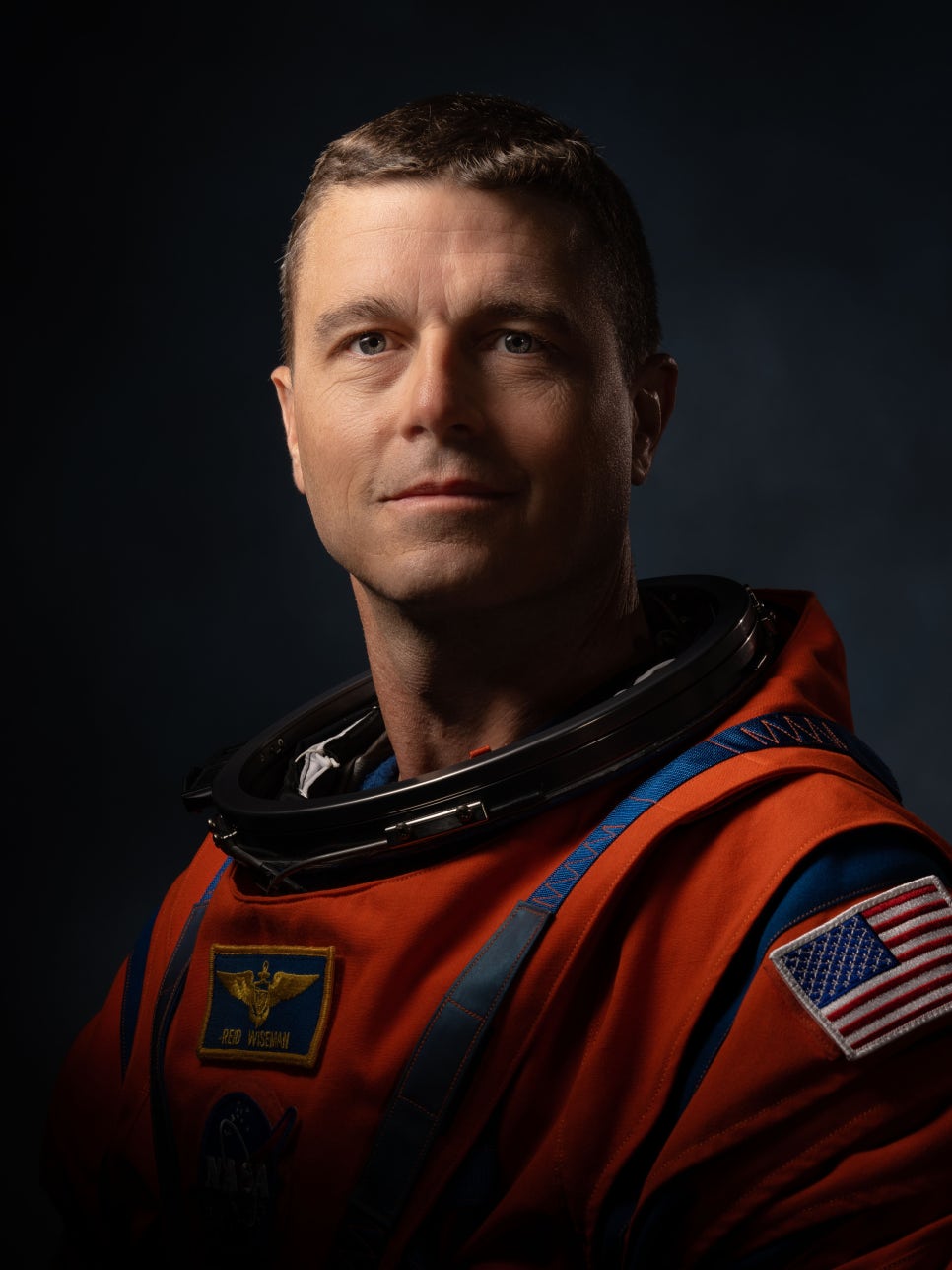
Commander
Reid Wiseman
United States
Oldest person to travel beyond low Earth orbit
A former naval test pilot, Wiseman spent 165 days aboard the ISS in 2014. This mission makes him the oldest person to travel beyond low Earth orbit.
Pilot
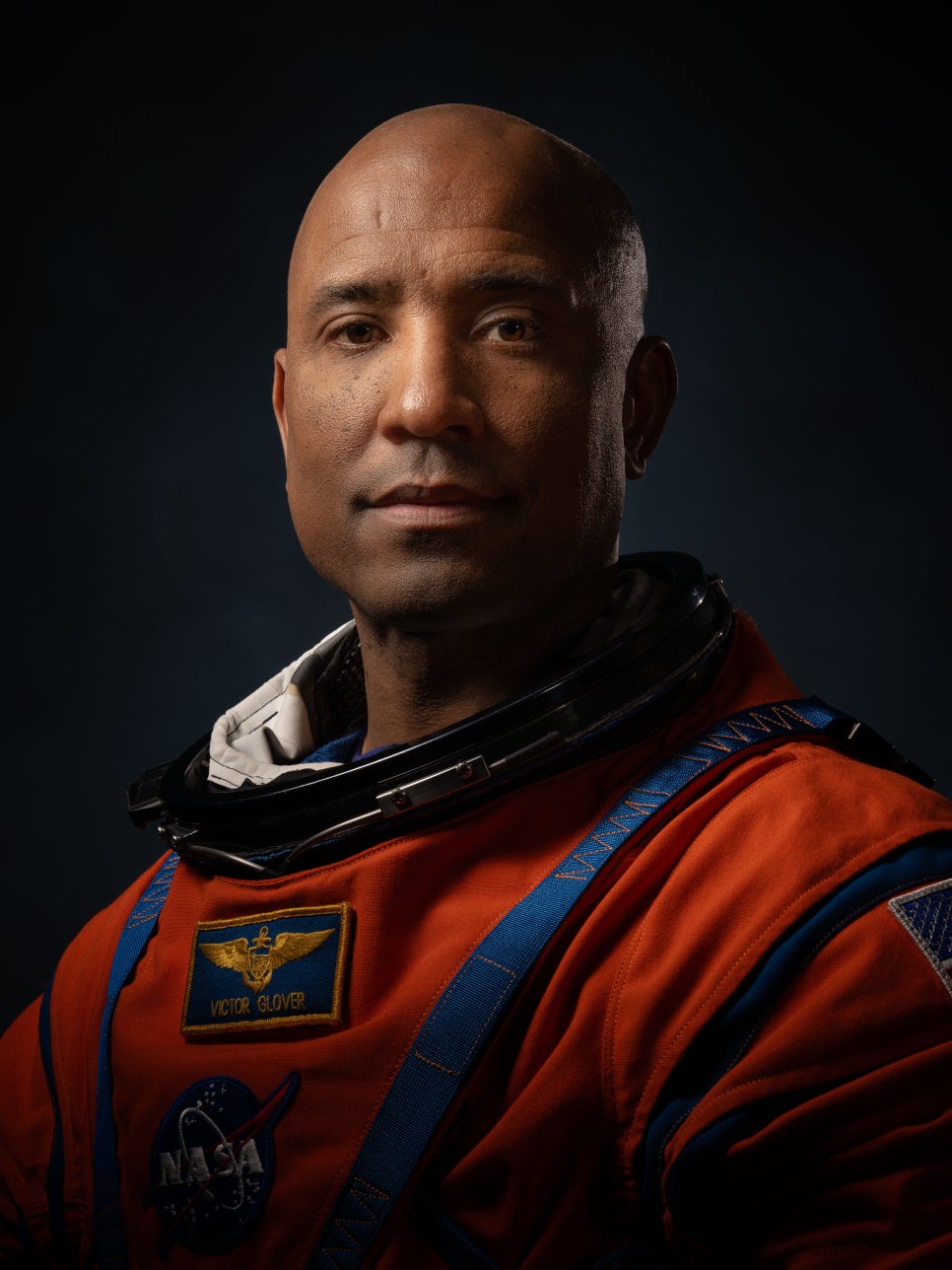
Victor Glover
United States
First person of color to travel beyond low Earth orbit
Glover flew to the ISS aboard SpaceX Crew Dragon in 2020, spent 168 days there, and completed four spacewalks. He becomes the first Black astronaut to travel into deep space beyond low Earth orbit.
Mission Specialist
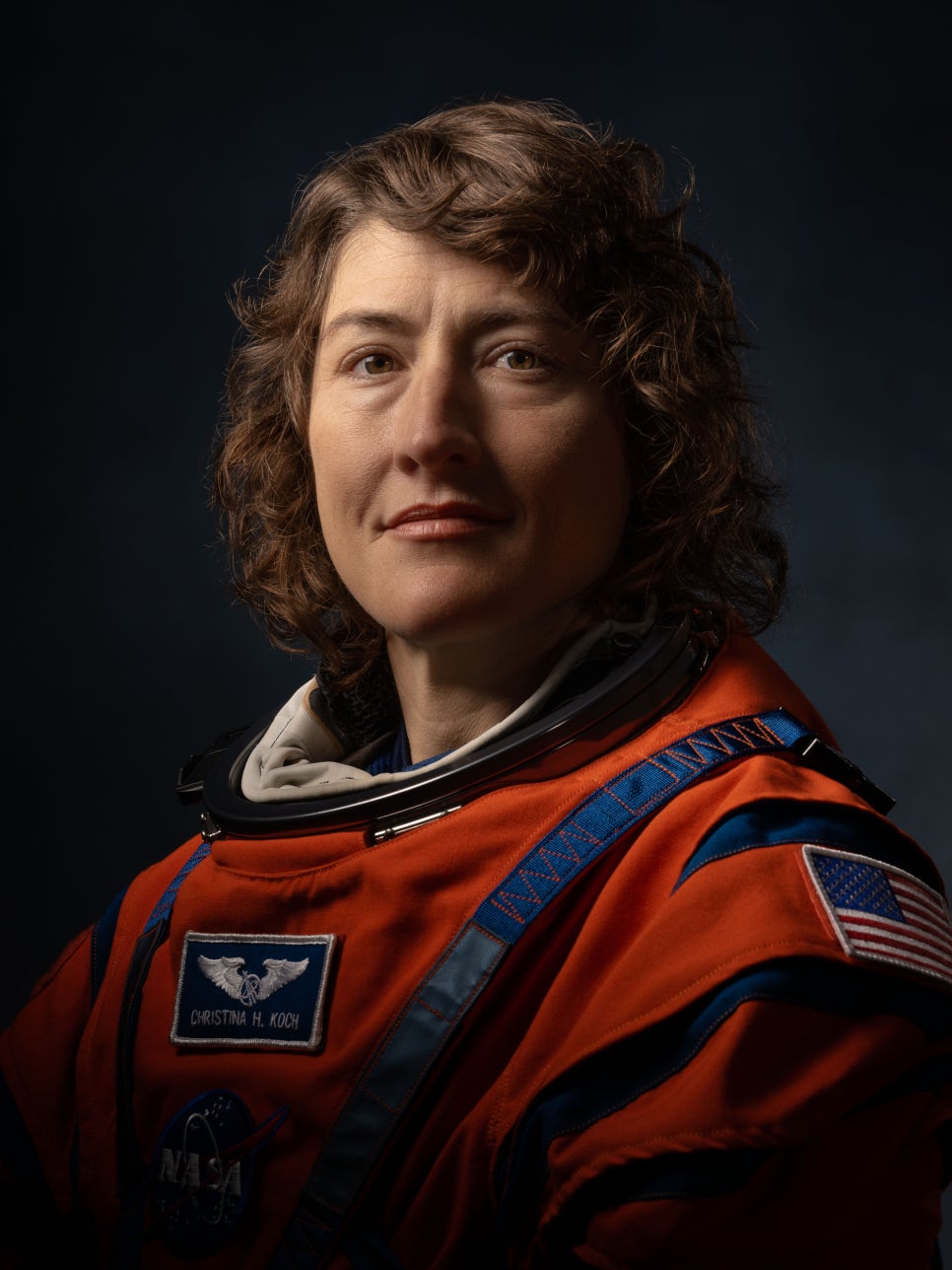
Christina Koch
United States
First woman on a lunar flyby
Koch set a women’s record with 328 consecutive days aboard the ISS. In 2019 she joined Jessica Meir for the first all-female spacewalk.
Mission Specialist
Jeremy Hansen
Canada
First non-American on a lunar flyby
A former Royal Canadian Air Force CF-18 fighter pilot, Hansen is making his first spaceflight.
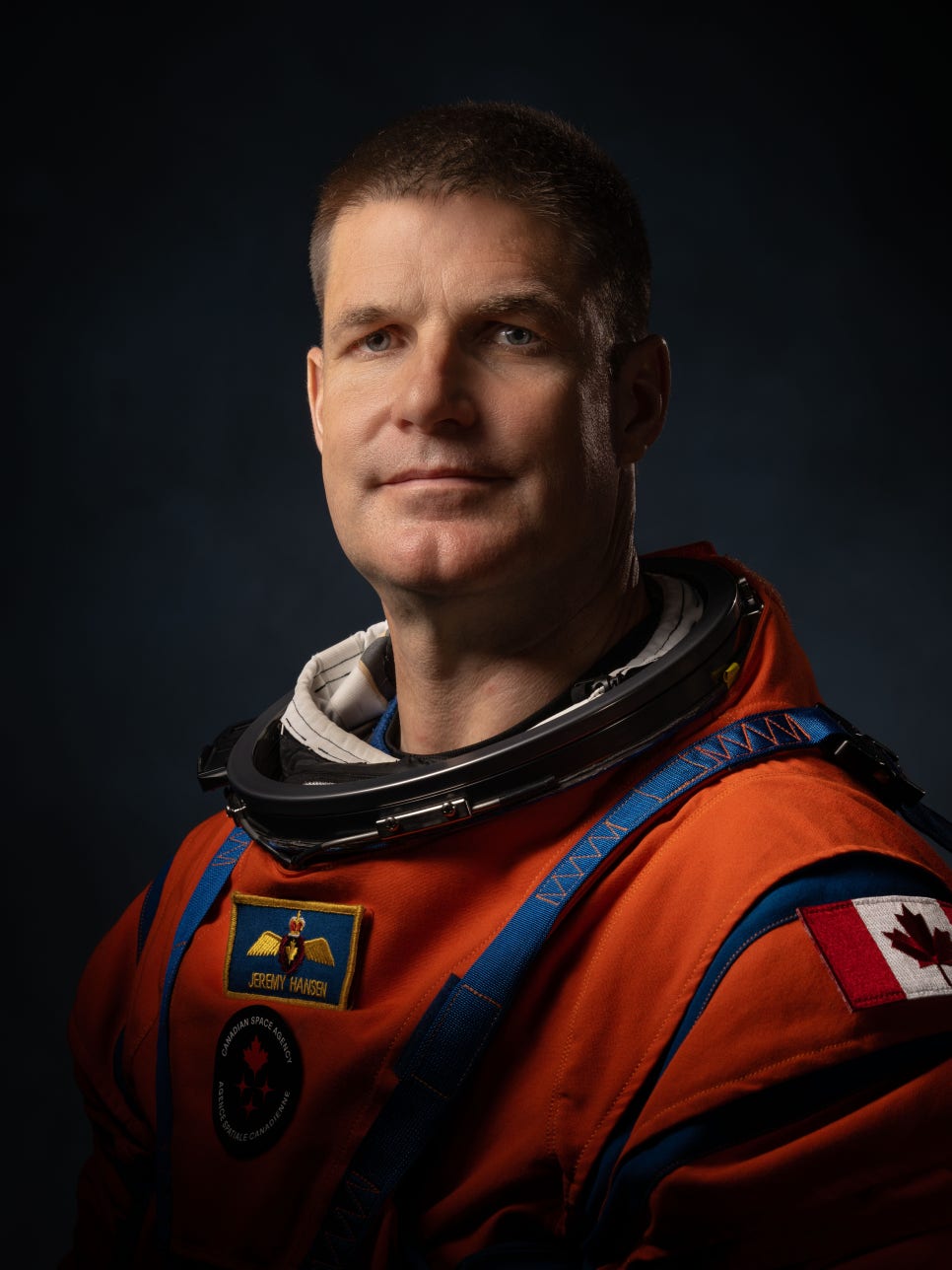
I hope this return to crewed lunar exploration after half a century helps more people feel that the Moon is somewhere they, too, could go.
How this differs from Apollo: why there is no landing
Going to the Moon and landing on it are different things. Artemis II does not land. Instead, it follows a free-return trajectory around the far side of the Moon and back toward Earth.
The principle recalls Apollo 13’s return after the accident in 1970: lunar gravity bends the spacecraft’s path back toward Earth. By leaving the landing for a later mission, Artemis II can focus on testing Orion’s life support, communications, and crew responses to deep space with actual people aboard.
Artemis II is a test flight. In the program revision NASA announced in 2026, Artemis III targets a low-Earth-orbit docking demonstration in 2027, and Artemis IV targets a lunar landing in 2028. Just as Apollo 8 orbited the Moon in 1968 to prepare for a later landing, this flight builds experience for the next stage.
Schedule note This reflects NASA’s revised 2026 plan. The years given for later missions are targets, not completed achievements.
The rocket and spacecraft: SLS and Orion
The launch vehicle is SLS, the Space Launch System. Standing 98 meters tall, it is the most powerful crewed launch vehicle built since the Apollo era’s Saturn V. Four RS-25 engines, inherited from the Space Shuttle program, and two solid rocket boosters produce 8.8 million pounds of thrust at liftoff.
The crew travels in Orion, flying with people aboard for the first time. Artemis I completed an uncrewed test with mannequins in 2022. Orion carries a heat shield designed for atmospheric reentry at approximately 40,000 km/h, about Mach 32, along with systems for crew protection and the life support needed for a lunar round trip.
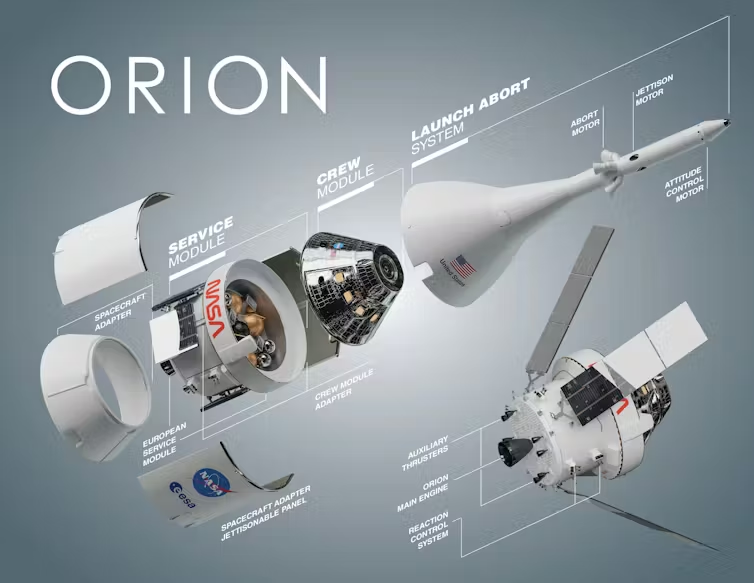
Orion’s components
A route of roughly ten days
Day 0 · April 1
Launch and entry into Earth orbit
Liftoff takes place at 6:35 p.m. local time, or 7:35 a.m. on April 2 in Korea. After core-stage separation, Orion enters an elliptical Earth orbit. Koch and Hansen begin checking the life-support systems.
Flight days 1–2 · April 1–2, U.S. Eastern Time
Proximity operations and preparation for TLI
On the first day, the crew tests manual proximity maneuvers using the ICPS upper stage as a target. On the second, Orion performs its translunar injection burn.
April 2–6, U.S. Eastern Time
Four days of travel toward the Moon
After TLI, the spacecraft follows its free-return path, making trajectory corrections as needed.
Flight day 6 · April 6, or April 7 in Korea
Passing the far side and setting a distance record
Orion passes approximately 6,545 km above the lunar surface and reaches a maximum distance of about 406,771 km from Earth. Communications with Earth are interrupted while the Moon lies between the spacecraft and its ground stations.
Flight day 10 · April 10, or April 11 in Korea
Splashdown in the Pacific
Orion reenters Earth’s atmosphere at approximately 40,000 km/h, protected by its heat shield. Splashdown in the Pacific is followed by recovery operations.
Why now?
Artemis is not simply a scientific expedition. As China prepares its own crewed lunar program and proposes a base near the lunar south pole, the American program has an unmistakable geopolitical setting. The question of who reaches the Moon is tied to who will shape deep-space resources and rules over the next half-century.
At the same time, this mission contains something that does not fit neatly into that competition. The first Black deep-space traveler, the first woman on a lunar flyby, and the first non-American participant in a crewed lunar mission are aboard. Remembering that all twelve Apollo moonwalkers were white men, I see this crew as more than a diversity campaign. It is a tangible statement that participation in space exploration is widening.
Artemis II series, Part 1 | April 2, 2026
Next: The First Days in Space
References
NASA: revisions to the Artemis program
Continue reading
The First Days in Space: What Artemis II Set in Motion, Part 2