
Thirst, Part 1: Sin, Desire, and Free Will
Reading sin and choice through a vampire’s desire, from Park Chan-wook’s Thirst to the stories and images it brings to mind.
Who this essay is for
Readers who have seen the film and want to consider another interpretation and its background. This essay contains spoilers for the plot and ending.
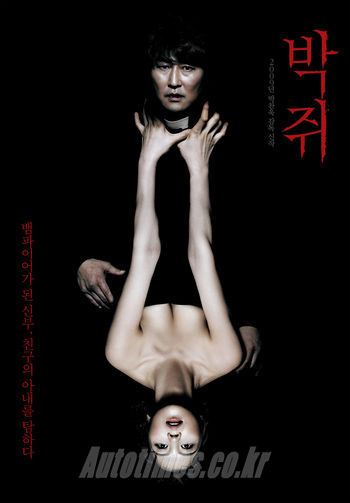
Thirst (Park Chan-wook, 2009)
References to quantum mechanics here are cinematic metaphors. A vampire’s relation to life and death is not the same as physical superposition or entanglement.
An old vampire story
The vampire is a subject that has been remade so often that it feels like broth boiled from the same bones. Bram Stoker’s Dracula is a defining vampire novel, but it was not the first. Works such as The Vampyre and Carmilla came earlier. Dracula also introduced Van Helsing. The terror that an irrational, supernatural being brings to human life has helped keep the vampire available to horror. Thirst does not focus on this aspect. It is more interested in other familiar subjects that modern stories keep returning to.
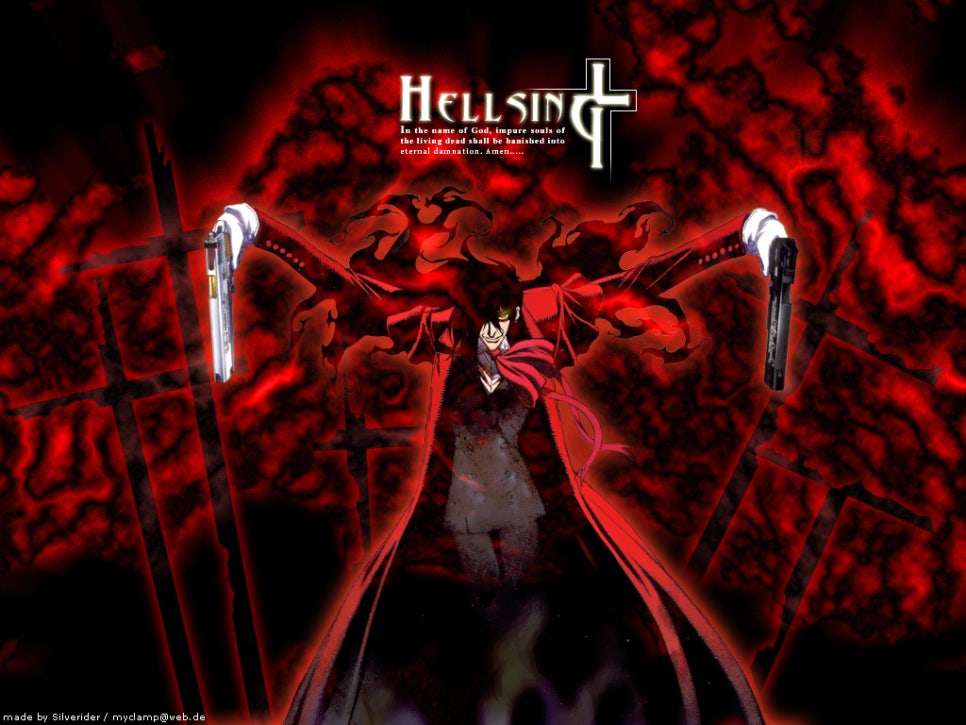
Alucard in Hellsing is a reimagining of Dracula. Rather than mixing the romances of other Dracula adaptations into the same setting, I want to compare the human desires that remain in a vampire with those in Thirst.
Mina Harker is not depicted often in Hellsing. Integra, the organization’s leader, appears repeatedly. Her fate has been tied to the Hellsing organization since childhood. In that sense, Tae-ju’s life in Thirst reminds me more of Integra than of Mina Harker.
Hellsing draws on many subjects, including Nazis and the occult. Alongside it, the wider tradition of Dracula stories brings love to mind. Thirst is also about love, but the love is adulterous. More interesting still, the person committing adultery is a priest.
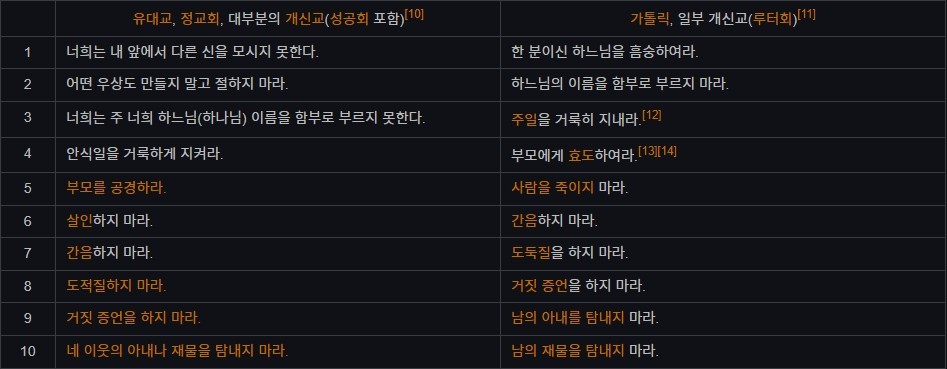
The Ten Commandments. Image source: Namuwiki.
Original sin and prohibition
Many acts described as sins in religion remain wrongs in modern society. How did religious prohibitions come to overlap with human law? That question does not mean that all modern law derives from them. First, I need to say what I mean by sin: stepping outside something one is obliged to observe. In a Protestant context, the word brings original sin to mind, Adam and Eve eating the fruit after listening to the serpent in Eden. The forbidden fruit is placed in the middle of the garden, and God tells them not to eat it.
“3. God said that you must not eat the fruit of the tree in the middle of the garden, or even touch it, lest you die.” (Genesis 3:3, translated here from the Korean quotation.)
Source of the Korean quotation: Korean Bible Society.
Placing it conspicuously in the middle of Eden and then forbidding them to eat it seems little different from leaving something a child wants within reach and saying, “Don’t touch.” In this reading, God seems either spiteful or, if he is truly the only God, perhaps engaged in a wager with himself: “How long will those two last?” The account continues:
“4. The serpent said to the woman, ‘You will certainly not die.’”
“5. ‘God knows that when you eat it, your eyes will open, and you will be like God, knowing good and evil.’”
“6. The woman saw that the tree was good for food, pleasing to the eye, and desirable for gaining wisdom. She took its fruit and ate it. She also gave some to her husband, who was with her, and he ate it.”
Genesis 3:4–6. The passages above are translated here from the Korean quotations.
Source of the Korean quotations: Korean Bible Society.
I read God’s warning about death as true: in Eden, Adam and Eve would have lived forever, or something close to it. In that respect, the serpent deceives Eve. Yet the promise that moves her is also fulfilled. Their eyes open, they know good and evil, and they come closer to God. In my reading, they have already committed the sin of wanting to be like God before eating the fruit. That sin is pride.
This pride comes before the original transgression. Although the serpent tempts them, Adam and Eve could refuse. I read their decision as driven not simply by curiosity, but by the desire to become like God. I see a similar problem early in Thirst. Sang-hyun, faithful to his role as a priest, wants to sacrifice his own body. An early exchange equates suicide with martyrdom; I hear it as a question about how the director sees the martyr. From the beginning, then, Sang-hyun seems to use the language of scripture while committing the pride of wanting to approach God. At the end he chooses death in the sunlight and takes Tae-ju with him. For me, this returns to that earlier equation of suicide and martyrdom.
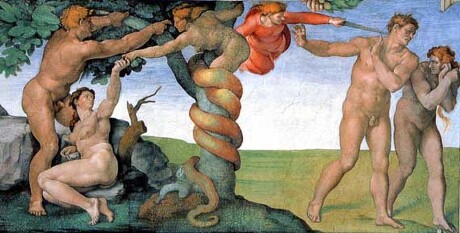
After expulsion from paradise
Expulsion from Paradise
The expulsion of Adam and Eve from Eden has long served as a metaphor. What was Adam, merely eating and sleeping in a space made by God and for God? From a modern perspective, he might look like a favorite pet.
Thirst is also full of images of repression and freedom. Sang-hyun volunteers to help the sick, yet I read him as constrained by his relationship with God, only seeking release through his final death. Becoming a vampire does not itself free him from that relationship. Tae-ju, by contrast, discovers and enjoys freedom when she becomes a vampire. Even their ideas of freedom differ. From a divine perspective, one could say that Tae-ju, too, remains in God’s hands. But Sang-hyun’s attachment is explicit: before killing the older priest, he receives absolution from him.
A film that asks about free will
This brings me to the question of whether free will exists. In theology, original sin and free will can coexist, since the presence of the forbidden fruit itself offers a choice. But something troubles me. If eating it was an act of pride, that pride began in Adam and Eve’s desire to see as God sees. Desire comes before the choice. If we place desire before free will, who determines that desire?
I cannot easily answer whether free will exists or whether the world is deterministic. Quantum mechanics alone cannot prove that free will is absent. What follows uses it more as a metaphor for reading the contradictions of a fictional being.
Spoilers for the manga Hellsing follow.
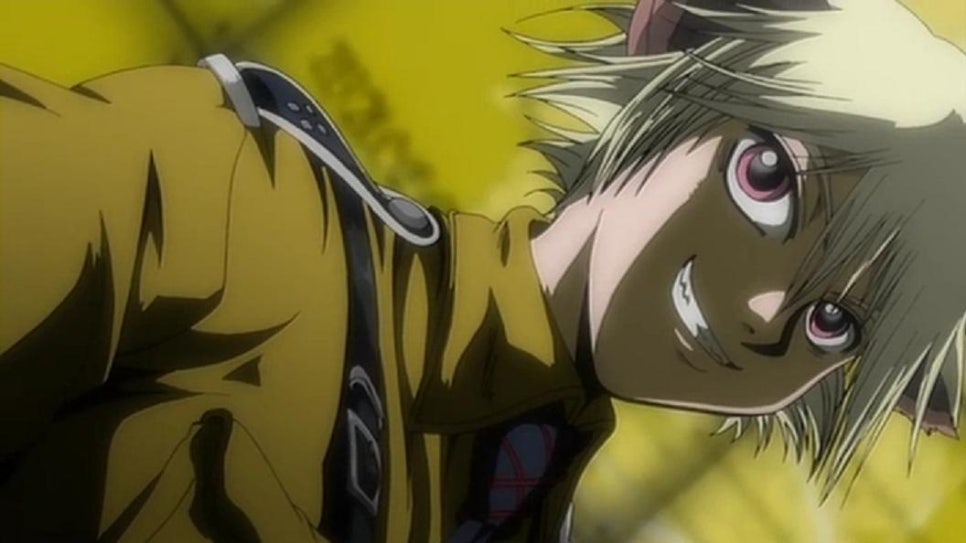
Warrant Officer Schrödinger in Hellsing
Quantum mechanics as a metaphor
Near the end of Hellsing, Alucard, or Count Dracula, has absorbed countless lives through blood. To defeat him, Warrant Officer Schrödinger cuts his own neck and enters the blood Alucard is absorbing after releasing his accumulated lives. The character draws on Schrödinger’s cat and the Cheshire Cat. Within the story’s fictional logic, his uncertain existence becomes mixed into those many lives, and Alucard is affected by it too. This is a narrative use of the idea of superposition, rather than an account of actual physics.
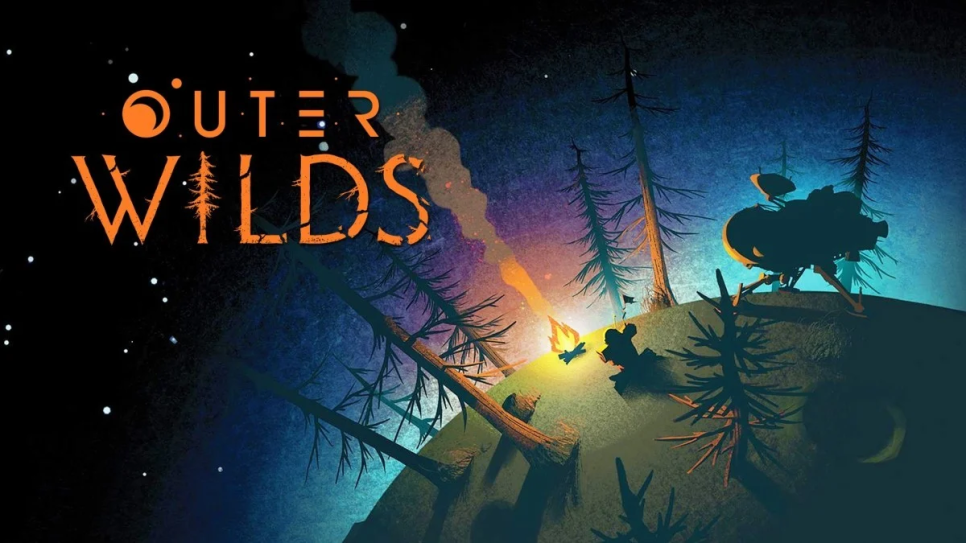
Outer Wilds. I recommend the game whether or not you are interested in quantum mechanics.
Outer Wilds develops related ideas in a detailed and engaging way. Quantum-inspired phenomena are central to its story. I am not a scientist and cannot claim a complete understanding of the subject, but the game can provide an imaginative point of entry for someone who thinks of quantum mechanics only as philosophy or science fiction. It can awaken curiosity, even though it is not a physics textbook.
Vampires are depicted as beings who pass through death and continue living in another way. I see an overlap of life and death in that image. It is not, however, the same phenomenon as quantum superposition or entanglement.
The everyday uncertainty of not knowing a future choice differs from the uncertainty principle in physics. The film’s question about choice remains even after making that distinction.
Kim Ok-vin as Tae-ju in Thirst
The ethics of drinking blood
Traditionally, vampires must drink blood to survive. Seen by itself, drinking blood is their way of feeding. Humans consume many plants and animals not only to stay alive but for the pleasure of taste. That differs from an account of feeding based solely on survival; we also consume for enjoyment. Sang-hyun tries to avoid killing directly by taking blood from a patient in a coma, drinking refrigerated blood, or feeding on people who want to die. Tae-ju hunts for pleasure and consumes more than she needs. From a human perspective, Sang-hyun’s approach may seem more humane. Yet vampires are stronger than humans. If humans justify consuming other living things through an assumption of superiority and strength, what prevents vampires from doing the same?
Who seems more human may depend on who is looking.
Continued in Part 2.